What does a knife edge actually look like — for real — after aggressive diamond sharpening?
I tested this under a microscope using 150 micron (0.15 mm) diamonds to better understand what actually happens in the steel and to verify some common claims about knife sharpening.
Coarse sharpening under the microscope
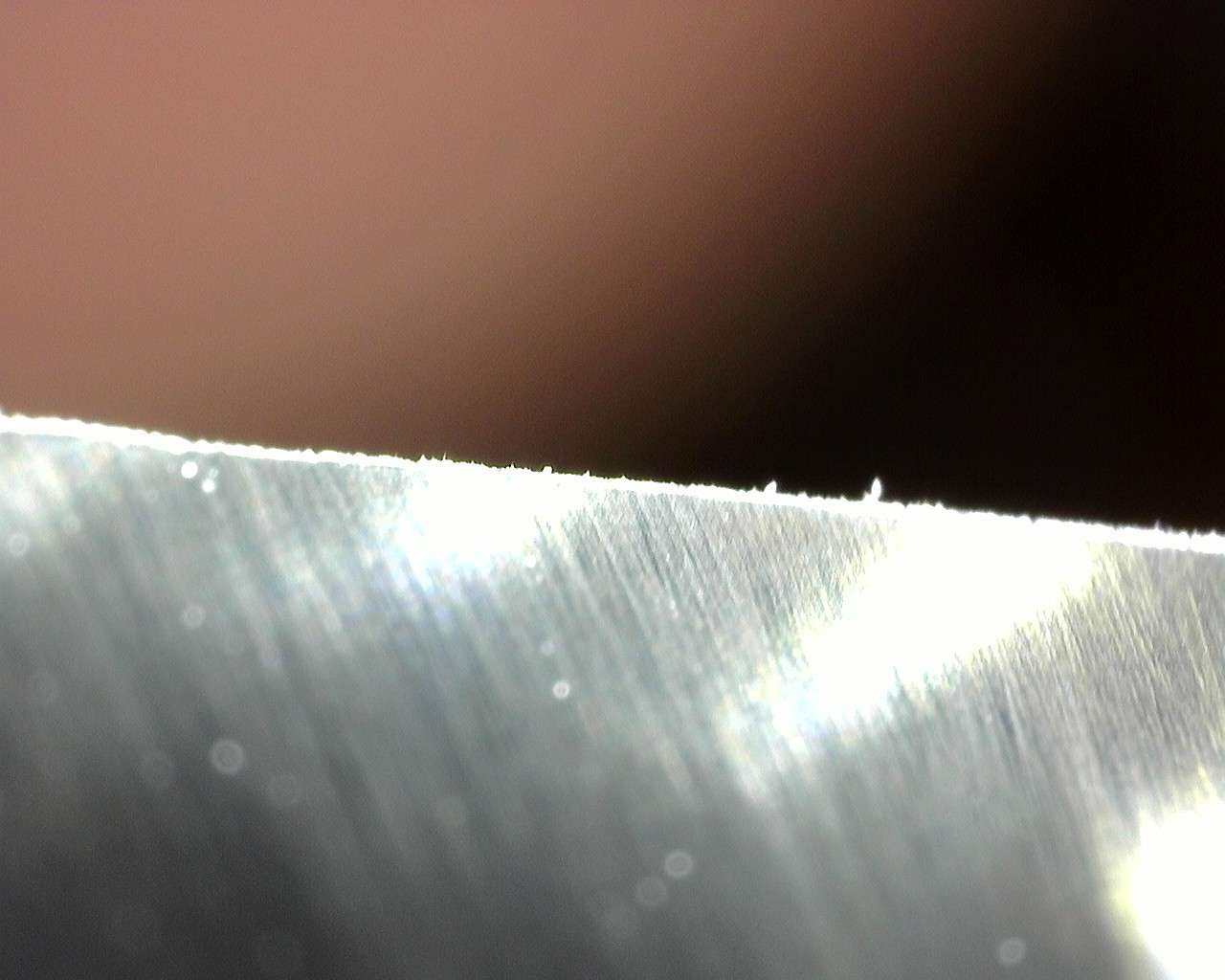
The image below shows an edge after aggressive sharpening using a filing motion. The goal here is not finish — but rapid material removal until the two sides meet.
At this stage they have not fully met yet, which means more work is required before the edge becomes truly sharp.

Common sharpening claims — tested
- “You should only pull the knife across the stone”
No noticeable difference compared to sharpening back and forth. - “You should only push the knife”
Same result — the sharpening direction itself does not seem critical. - Circular motions
Remove material faster than the classic “windshield wiper” motion. - “Starting too coarse destroys the edge”
Not true — but it does require significantly more refinement afterwards than many people expect.
What actually matters
After testing different methods, the conclusion became fairly clear:
- Sharpen until the two sides meet — nothing else matters before that
- Use light pressure to avoid folding the edge over
- Switch sides frequently for better control
After finer grits and polishing
The same edge after progression: 100 → 300 → 600 → 1200 grit + leather stropping.
The deeper scratches from coarse sharpening are still partially visible, but the finer scratches (~0.015 mm) now dominate the surface.

After 1200 grit and leather stropping
Reference: a brand new razor blade
For comparison — a completely new industrial razor blade at the same magnification:

Razor blade at the same magnification
Video: what it looks like in practice
100 grit — material removal and how the edge is formed
Conclusion
It is not the exact sharpening motion that determines how sharp your knife becomes.
What matters is controlled material removal until the edge meets — followed by gradual refinement step by step.
This is where diamond stones really make a difference: fast, controlled material removal and a sharpening process that can be repeated with precision.