How to use Gidden
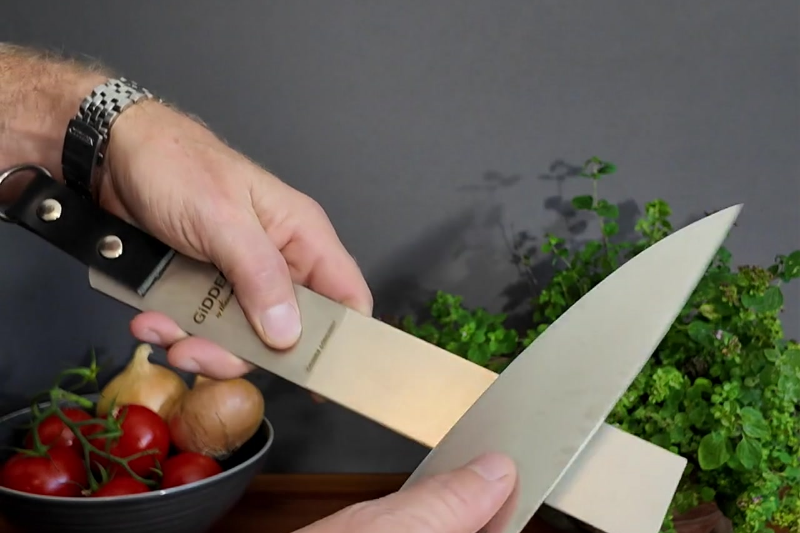
Gidden is a 3-in-1 tool for sharpening, honing and steeling your kitchen knife.
Here we show the complete process – from a dull knife to a sharp and well-maintained edge.
Not sure what the different terms mean? See our glossary →
1. The short guide
Video: approx. 1:30 minutes
A quick overview of the complete process:
Sharpen → Hone → Steel
In a hurry? This short video shows the recommended process from start to finish.
2. Want to know more? See the full guide
Video: approx. 3:40 minutes
In the longer guide, we go through each step in more detail and show you how to find the correct angle, how to work with the two diamond surfaces and how to finish with the steel surface.
Glossary
🔨 Sharpen – restore the edge
When a knife is dull, material needs to be removed to create a new edge.
Gidden's coarse 300-grit diamond surface is used for this.
Sharpen = restore a dull edge by removing material.
✨ Hone – refine the edge
After sharpening, a burr remains along the edge and the edge needs to be refined.
Gidden's fine 600-grit diamond surface is used to remove the burr and refine the edge.
This is also the step that can be done regularly, even daily, to keep the knife in good condition.
Hone = refine and maintain the edge by removing small imperfections and the burr.
🪒 Steel – straighten and maintain the edge
Finally, the rounded steel surface on the Gidden handle is used.
It straightens the edge and helps keep it stable between sharpening sessions.
This does not remove material. Instead, it straightens the edge so that it regains its sharpness. It is the same principle you often see chefs and butchers use with a traditional honing steel.
Steel = straighten and maintain the edge.
Gidden's three steps
A simple summary:
300 grit – Sharpen
Restore a dull edge.
600 grit – Hone
Refine the edge and remove the burr.
Steel surface – Steel
Straighten and maintain the edge.